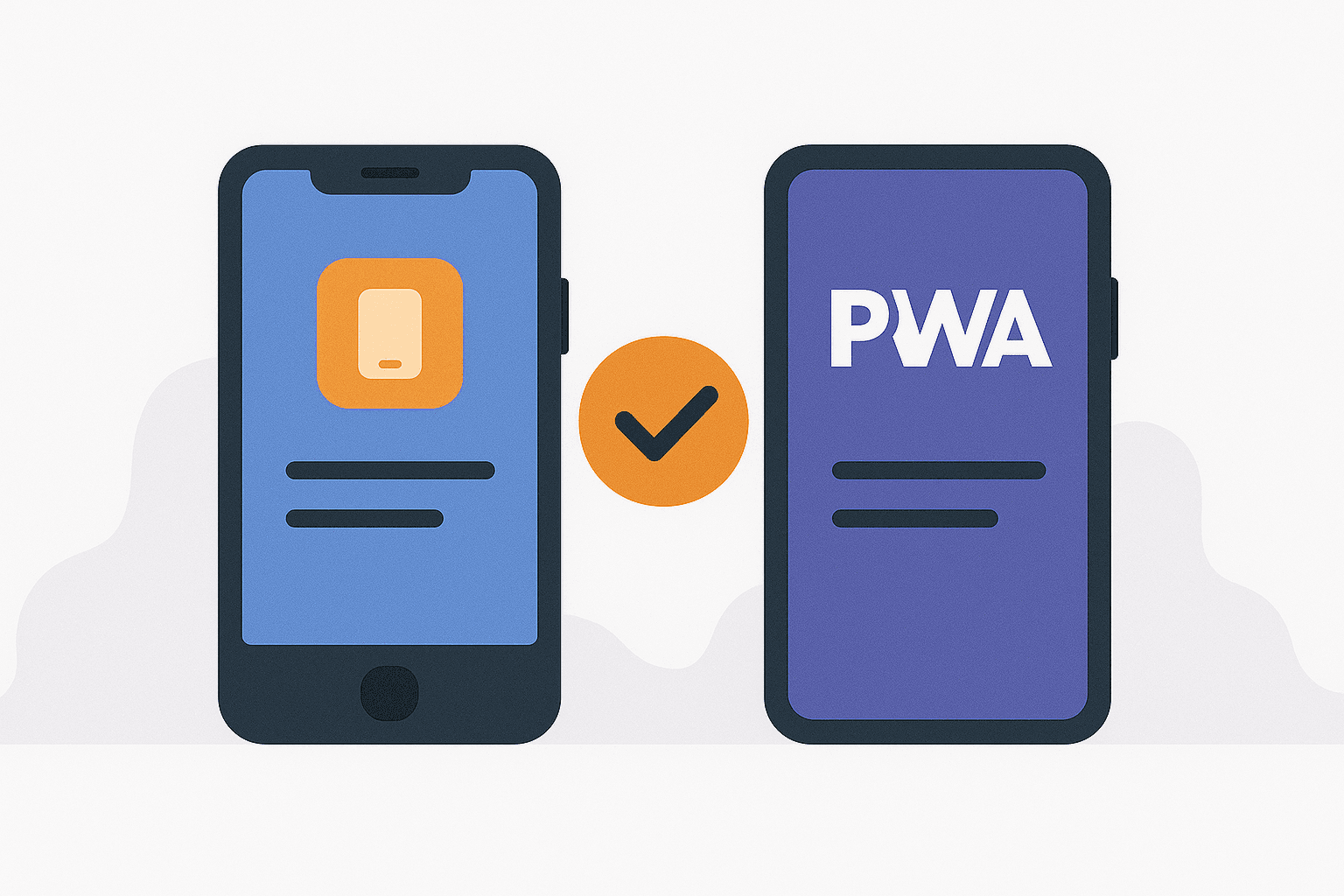
Native mobile apps are expensive. Progressive Web Apps (PWAs) promise a similar app-like experience without the App Store overhead.
For startups in the UAE, making the right choice can save you six figures and months of development. Here's how to decide.
User Experience & Acquisition
PWA (Progressive Web App)
- Installation: Directly from the browser with one click. No App Store.
- Discoverability: Indexed by Google, so they appear in search results.
- Offline Access: Supports offline caching for core functionality.
Native App
- Discoverability: The App Store and Play Store are powerful discovery engines.
- Trust & Credibility: An app store presence signals legitimacy for many users.
- Performance: Generally offers the smoothest, most integrated user experience.
Bottom Line: If your audience lives on Google and gets links via WhatsApp, a PWA often wins. If you need the branding power of app stores, native is the way to go.
Features & Device Integration
This is where the lines are drawn most clearly.
Go Native if you need deep integration with device hardware:
- Advanced camera/microphone access
- Complex background processes
- Integration with platform-specific APIs (HealthKit, Google Fit).
A PWA is often sufficient if your core needs are:
- Displaying content
- Basic push notifications
- Offline access to viewed pages
- Simple forms and user interactions
Budget and Speed to Market
This is the deciding factor for most startups.
- PWA: Costs 40-60% less than a native app on average. It can be developed and deployed in weeks.
- Native App: Requires separate development for iOS and Android. Involves a lengthy app store review process.
The Final Decision Tree
Here’s a simplified guide:
- Do you have a small budget and need to launch fast? → Go PWA.
- Is your app a simple extension of your website? → Go PWA.
- Is your business product-led and relies on a mobile-only UX? → Go Native.
- Do you need deep access to specific hardware features? → Go Native.